
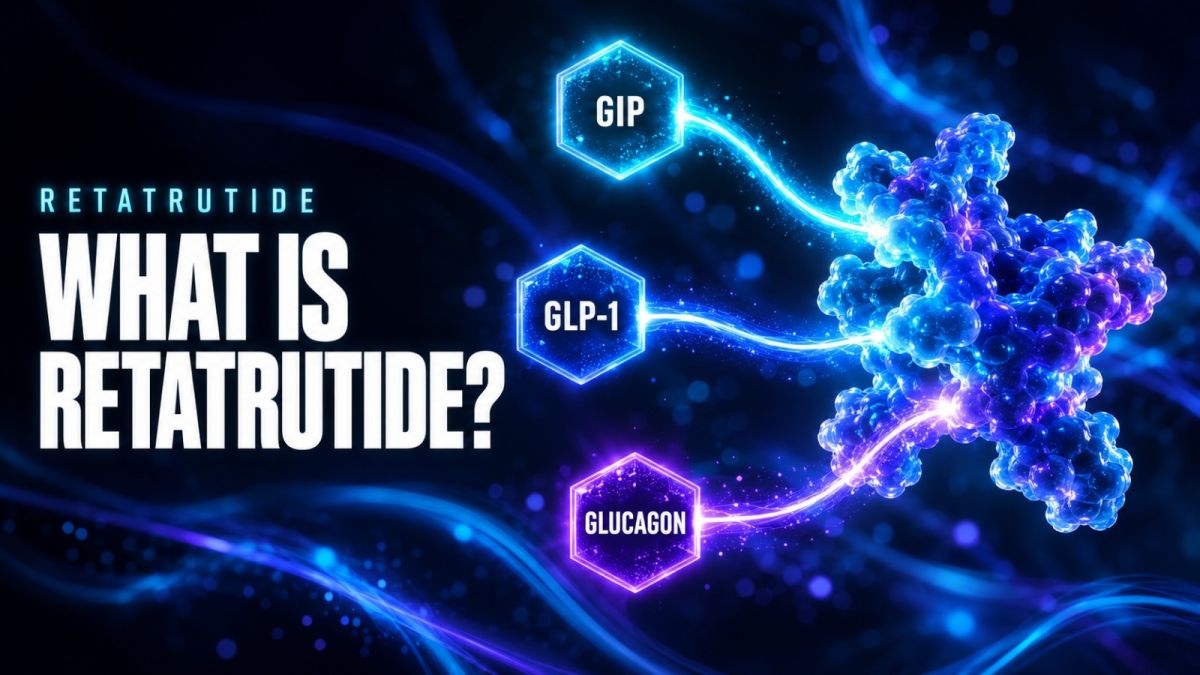
What Is Retatrutide? The Triple-Hormone Weight-Loss Drug Explained
Retatrutide is Lilly's weekly triple agonist (GIP, GLP-1, glucagon) with up to 28.3% weight loss in trials. What it does, side effects, and FDA status.
Written by Olha Orlyk. Updated October 22, 2026.
Retatrutide is an experimental weight-loss drug from Eli Lilly, given as a once-weekly injection, that activates three hormone receptors at once: GIP, GLP-1 and glucagon. That's why it's nicknamed a "triple agonist" and sometimes, informally, "GLP-3." In Phase 3 trials, people with obesity lost an average of up to 28.3% of their body weight over 80 weeks. It is not approved by FDA yet; Lilly plans to file by the end of the first quarter of 2027.
Here's what retatrutide does in the body, what the trials have shown, the side effects, and what to make of the versions being sold online.
Retatrutide in 30 Seconds
Retatrutide basics
What is it?
An investigational peptide drug for obesity and related conditions
Who makes it?
Eli Lilly, the maker of Mounjaro and Zepbound (research code LY3437943)
How is it taken?
A once-weekly injection under the skin in trials
What does it target?
GIP, GLP-1 and glucagon receptors
Best trial result
28.3% average weight loss at 80 weeks on 12 mg (TRIUMPH-1)
Approved?
No; FDA filing planned by Q1 2027
How to pronounce it
reh-tuh-TROO-tide
What Does Retatrutide Do?
Retatrutide copies the action of three natural hormones. Each one does something different, and together they push weight down harder than any single- or dual-hormone drug so far.
The three targets
GLP-1
Cuts appetite, slows stomach emptying, raises insulin when blood sugar is high
Ozempic, Wegovy, Mounjaro, Zepbound
GIP
Adds to the appetite and blood-sugar effects; may improve tolerability
Mounjaro, Zepbound
Glucagon
Increases energy use and fat burning, especially in the liver
Only retatrutide among late-stage drugs
In practice, people on retatrutide feel full sooner and think about food less, as with Ozempic or Zepbound. The glucagon component is the new ingredient. It's believed to raise the number of calories the body burns and to clear fat from the liver, which may explain both the extra weight loss and the dramatic liver-fat drops seen in early studies. For a side-by-side with the drugs people already know, see retatrutide vs tirzepatide.
What Is Retatrutide Used For?
Lilly is studying retatrutide for several conditions and plans to seek approval first for obesity, knee osteoarthritis pain and obstructive sleep apnea. It's also being tested in type 2 diabetes, heart disease and kidney disease. If it's approved, each use will be approved separately, based on its own trial results.
What the Trials Have Shown
Key results so far
Phase 2 (2023)
Adults with obesity
Up to 24.2% weight loss at 48 weeks
TRIUMPH-4 (Dec 2025)
Obesity and knee osteoarthritis
Up to 28.7% weight loss at 68 weeks, less knee pain
TRANSCEND-T2D-1 (Mar 2026)
Type 2 diabetes
A1C down up to 2.0 points; 16.8% weight loss at 40 weeks
TRIUMPH-1 (May 2026)
Obesity without diabetes
28.3% at 80 weeks on 12 mg (25.0% in the stricter analysis)
TRIUMPH-2 and -3 (Jul 2026)
Diabetes; heart disease
Up to 20.8% and 22.6% weight loss at 80 weeks
The full numbers, including how many people lost 30% or more, are in our retatrutide weight loss results breakdown.
Side Effects
The most common side effects are the familiar ones from this drug family: nausea, diarrhea, constipation and vomiting, mostly while the dose is increased. They were more frequent at higher doses; in TRIUMPH-1, 42.4% of people on 12 mg had nausea. Retatrutide also causes dysesthesia, a tingling or burning skin sensitivity, in about 12% of people on the higher doses. Heart rate rises modestly. See the full side-effects guide.
Is Retatrutide a Peptide? A Steroid? A GLP-1?
- 1A peptide: yes. Like semaglutide and tirzepatide, it's a lab-built chain of amino acids with a fatty-acid tail that lets it last about a week.
- 2A steroid: no. It has nothing in common with anabolic or corticosteroids.
- 3A GLP-1: partly. It's a GLP-1 receptor agonist, but also a GIP and glucagon agonist, which is why it's called a triple agonist.
- 4"GLP-3": not a real hormone. It's an informal nickname, often used by sellers of unapproved versions.
Can You Get Retatrutide?
Not legally outside a clinical trial. Retatrutide hasn't been approved, and FDA says it can't be compounded. Products sold online as retatrutide, "reta" or "GLP-3" for "research use only" are not the drug used in Lilly's trials; their dose, purity and sterility are unknown. For the regulatory timeline, see our approval watch.
You may also see retatrutide sold online under the name "GLP-3 RT." That is not a new molecule or an approved product; our guide to what GLP-3 RT actually is explains where the name came from and why those vials are not the trial drug.
The question that follows what retatrutide is tends to be how quickly it works. Our week-by-week timeline, how fast does retatrutide work, pieces together the phase 2 curves with the 80-week and 104-week TRIUMPH-1 results and compares them with semaglutide and tirzepatide at the same timepoints.
Bottom Line
Retatrutide is Lilly's next-generation obesity drug: a weekly injection that adds glucagon to the GLP-1 and GIP effects of tirzepatide. It has produced the largest weight loss of any obesity drug in trials, with side effects similar to the class but somewhat more frequent at the top dose. It isn't approved yet; a filing is expected by early 2027.
FAQ
An investigational once-weekly injection from Eli Lilly that activates GIP, GLP-1 and glucagon receptors, studied mainly for obesity.
It reduces appetite, slows digestion, improves blood sugar and appears to increase energy use and liver fat burning, leading to large weight loss.
No. Lilly plans to submit it to FDA by the end of Q1 2027.
"GLP-3" isn't a real hormone. It's a nickname for retatrutide, often used by online sellers of unapproved products.
Ozempic (semaglutide) activates one receptor, GLP-1. Retatrutide activates three and produced roughly twice the average weight loss in trials.
Eli Lilly, the company behind Mounjaro and Zepbound.
Sources
- 1What to know about retatrutide, Eli Lilly
- 2Retatrutide Phase 2 trial, New England Journal of Medicine, 2023
- 3Lilly TRIUMPH-1 results, Eli Lilly, May 2026
- 4TRIUMPH-2 and TRIUMPH-3 results, PharmExec, July 2026
- 5FDA's concerns with unapproved GLP-1 drugs, U.S. Food and Drug Administration

Olha Orlyk
Author
Comments (0)
Be the first to comment on this article.
More articles